
Rebuilding the Foundation Your Smile Needs
Dental implants are the gold standard for replacing missing teeth, but they require a certain amount of healthy jawbone to anchor securely and function long-term. When bone loss has occurred, whether due to tooth extraction, gum disease, injury, or simply the passage of time, there may not be enough bone present to support an implant without first rebuilding that foundation. Bone grafting is the procedure that makes implant treatment possible for patients who would otherwise not qualify.

Did you know…
that tooth loss triggers bone resorption almost immediately? Within the first year after a tooth is extracted, the surrounding bone can lose up to 25 percent of its width. Over the following years, both the height and density of the bone continue to diminish. This is why timing matters after tooth loss. The sooner a patient is evaluated for implant treatment or a ridge preservation procedure, the more bone can be conserved and the less grafting may ultimately be required.
Types of Bone Grafting Procedures
Bone grafting is not a single procedure, it is a category of treatment with several approaches, each suited to a specific clinical situation and degree of bone loss. Dr. Azimi will determine which type of graft is appropriate based on where the deficiency is located, how much bone needs to be regenerated, and what implant treatment is planned for that site.
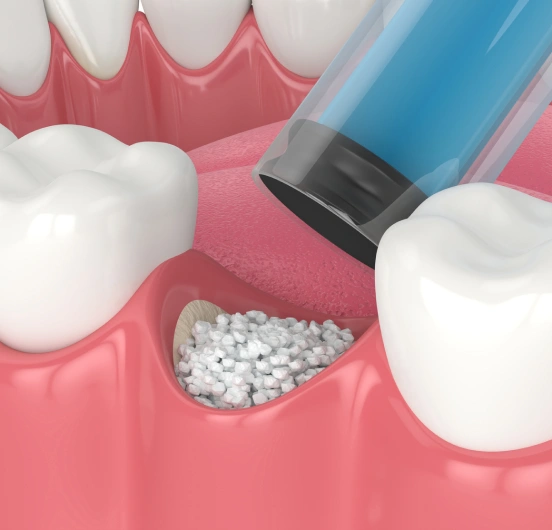
- Socket Preservation (Ridge Preservation): Performed immediately after a tooth extraction, socket preservation places graft material into the empty socket to minimize bone loss and preserve the jaw for future dental implants. This proactive procedure helps maintain the natural shape of the ridge and can reduce the need for more extensive grafting later.
- Ridge Augmentation: When the jawbone has become too narrow or thin after tooth loss, ridge augmentation rebuilds bone volume to create a stable foundation for one or more dental implants. Over time, the graft integrates with your natural bone, restoring the strength and dimensions needed for successful implant placement.
- Sinus Lift (Sinus Augmentation): A sinus lift is used when there is not enough bone in the upper back jaw for implants. The procedure gently raises the sinus membrane and adds graft material to increase bone height, creating the support needed for long-term implant stability in this area.
- Block Grafting: For more advanced bone loss, a small block of bone is secured to the deficient area to restore bone volume. This approach provides additional structural support and is often recommended when standard grafting materials alone cannot achieve the required bone thickness or height.
Find Out Whether Bone Grafting Is Part of Your Implant Plan
If you have been told you do not have enough bone for dental implants, or if you are in the early stages of exploring your options after tooth loss, a consultation at Falcon Dental Group is the right starting point. Dr. Azimi will evaluate your bone structure using 3D imaging, determine what grafting, if any, your case requires, and develop a treatment plan that maps the most direct route to the implant restoration you are looking for. Our office serves patients throughout Harper Woods, Grosse Pointe, and the surrounding communities.